Question 1 of 5
Which ocean layer receives enough sunlight for most photosynthesis?
Answer & explanation
The upper sunlight zone
The upper euphotic zone receives enough light for photosynthetic producers.
A LITTLE EVERY DAY. A WORLD TO DISCOVER.
5 questions · Untimed · Free
What changes as you descend below the waves? Explore sunlight, pressure, salinity, surface currents and the way kelp stays attached to rock. Five questions, including one illustrated example, introduce ideas from Oceans & Marine Systems.
This five-question sample is free. The full downloadable topic is included with optional Arca Curiosa Plus.
Question 1 of 5
The upper sunlight zone
The upper euphotic zone receives enough light for photosynthetic producers.
Question 2 of 5
It increases
The weight of overlying water increases pressure with depth.
Question 3 of 5
The concentration of dissolved salts
Salinity is the concentration of dissolved salts; it can vary with precipitation, evaporation, and other local conditions.
Question 4 of 5
Wind dragging on surface water
Global winds exert drag on surface water and help set surface currents in motion.
Question 5 of 5
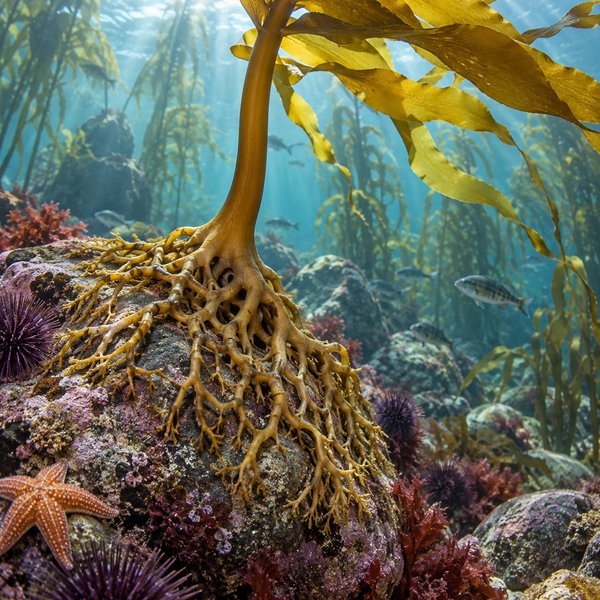
Anchor the kelp to the rock
The holdfast attaches kelp to its rocky substrate, while blades collect sunlight and gas-filled bladders in many species help with buoyancy. These structures have different roles even though kelp can resemble a rooted land plant.
A small beginning. A whole world to explore.
0/ 5 correct
Every explanation is another connection. Take an idea with you, or follow your curiosity into a new category.
Find Oceans & Marine Systems in the app ↗Send your score and this quiz to someone curious.
FROM ANSWERING TO UNDERSTANDING
Separate a condition in the water from a process that moves it or a structure used by an organism. After each answer, describe what was being measured, moved or supported. The kelp illustration supports the text; you do not need to identify an unlabeled detail to answer.
Read further with a quiz source: NOAA National Ocean Service: How far does light travel in the ocean?Choose a question that surprised you. Explain the answer in your own words and open its source link if you want to explore further. You can try again; the score reflects this short quiz, not your mastery of the whole category.
Read examples and explanations in the learning guide →
Keep exploring: Science & Nature or World & Geography.
ARCA CURIOSA
Continue in the free Arca Curiosa app for more questions, learning paths, and progress you can return to.
Find Oceans & Marine Systems in the app ↗